15:56 Carbon Footprint of Wood Briquettes vs Coal and Gas | |
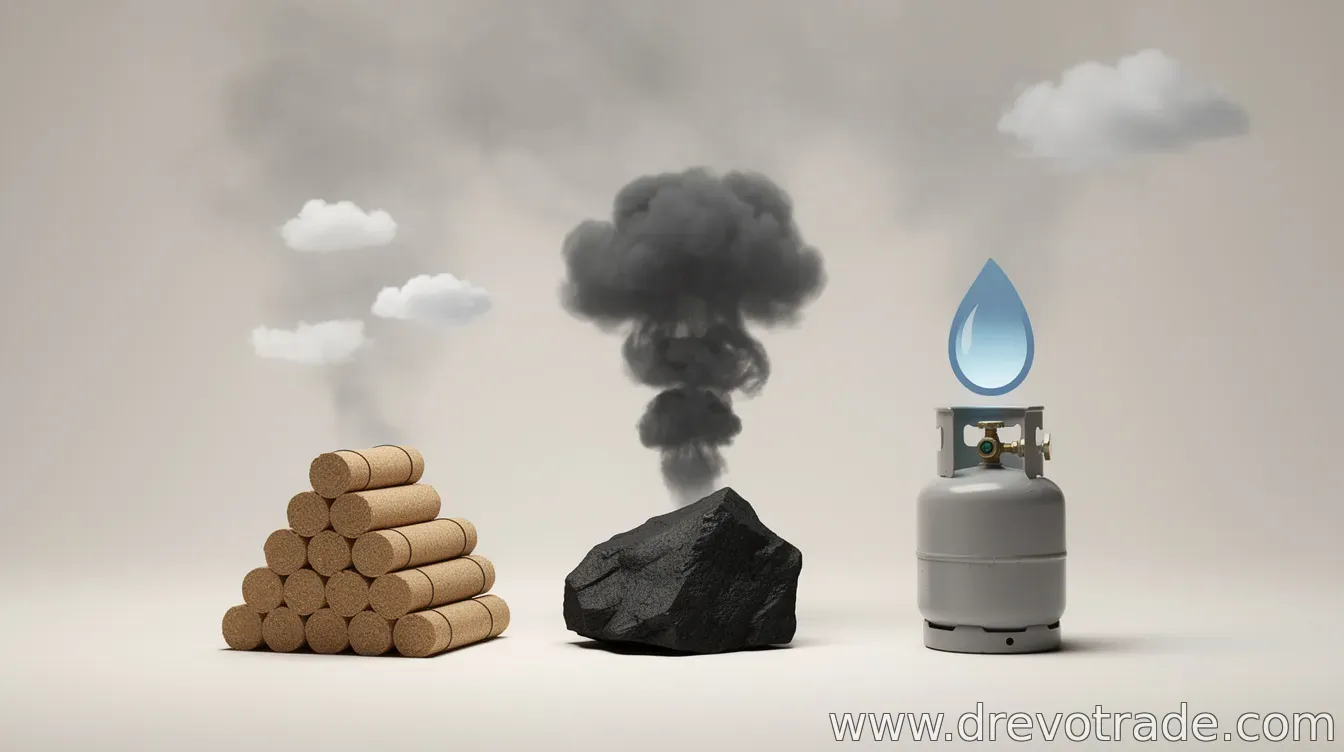 Wood briquettes can look climate-friendly because they come from biomass. However, “carbon footprint” comparisons between wood briquettes, coal, and gas aren’t determined by fuel type alone—they depend on how the fuel is produced, how efficiently it burns, and whether the wood is sourced from sustainably managed forests or from higher-carbon supplies. At the point of burning, all three fuels emit greenhouse gases. Coal and gas release carbon that has been stored underground for millions of years, while wood briquettes release carbon that was recently captured from the atmosphere as the trees grew. Climate impact calculations often treat this differently, which is why results vary across studies. 1) Direct emissions: what comes out of the chimneyWhen burned, coal typically has the highest carbon dioxide (CO₂) emissions per unit of energy among the three. Natural gas usually emits less CO₂ per unit of energy than coal. Wood briquettes fall in between depending on combustion performance and the fuel’s energy density. Two practical factors can swing wood briquettes’ direct emissions upward: high moisture content (which wastes energy boiling off water) and inefficient combustion (which can increase incomplete combustion and related air pollutants). Dry, well-designed briquettes burned in properly tuned stoves or boilers generally perform better. 2) Lifecycle emissions: where the real comparison often landsLifecycle assessments (LCAs) account for more than tailpipe smoke. They may include harvesting, drying, processing into briquettes, transport, and the fate of carbon stored in trees. Many LCAs credit biomass with “near-neutral” CO₂ at the point of release, assuming regrowth absorbs roughly equivalent CO₂ over time—an assumption that holds only under certain sustainability and time-horizon conditions. Coal’s lifecycle footprint tends to be higher because mining and processing add emissions, and because its carbon is largely not part of an active short-rotation carbon cycle. Natural gas also has a lifecycle footprint, and importantly, methane leaks during extraction and distribution can add a climate penalty that can narrow the gap versus other options depending on leak rates. 3) Typical direction of results (with big caveats)In many commonly cited scenarios, wood briquettes show lower lifecycle greenhouse-gas emissions than coal, especially when feedstock is waste residues or by-products and when forests are managed to maintain or increase long-term carbon stocks. Against natural gas, the picture can be closer: wood can be competitive, but outcomes depend heavily on whether sustainable regrowth is assured and how quickly regrowth offsets the emissions. Time horizon matters. If regrowth is slow or if biomass sourcing causes carbon stock declines, the near-term climate benefit can shrink—or temporarily reverse—particularly in calculations using shorter time windows. 4) What to look for when choosing or evaluating briquettesIf you’re trying to compare “real-world” carbon footprints, the biggest drivers are often controllable or at least knowable:
Also, note that while this article focuses on carbon footprint, wood combustion can increase local air pollutants (such as particulate matter). Even if CO₂ is lower under some assumptions, air-quality impacts may still be a policy and health consideration. Bottom line: Wood briquettes are frequently lower in lifecycle CO₂ than coal and can be competitive with natural gas, but the advantage is not guaranteed. It hinges on sustainable sourcing, low moisture and high combustion efficiency, and whether regrowth and carbon-stock accounting assumptions hold over the relevant time frame. If you tell me your region (or whether you’re comparing for home heating, industrial heat, or power generation) and the type/specification of the briquettes (moisture %, heating value if available), I can outline a more tailored comparison approach and what emission factors you’d likely use. | |
|
| |
Related materials:
![]()
| Total comments: 0 | |